


 Home
EVA vs PUR: Lay-Flat, Corner Damage & Glue Oozing Showdown
 Nov 12,2026

 SESE
EVA vs PUR: Lay-Flat, Corner Damage & Glue Oozing Showdown
When choosing a binding method for paperback books, the adhesive plays an important role in determining the book's durability, flexibility, and overall appearance. EVA and PUR are two widely used adhesives in perfect binding, each offering different advantages in terms of bonding strength, page retention, and production requirements.
But which one performs better? Does PUR really help books open flatter? Can it reduce loose pages and corner damage? And what causes glue to ooze from the spine?
In this guide, we compare EVA and PUR binding from a practical book production perspective, covering their key differences, opening performance, page retention, adhesive overflow, and quality control. Whether you are a publisher, author, or book buyer, understanding these differences can help you choose the right binding solution for your project.
1. EVA vs PUR: Understanding the Key Differences
EVA (Ethylene Vinyl Acetate) and PUR (Polyurethane Reactive) are two common adhesives used in perfect-bound paperback books. Although both bond the book block to the cover, their chemical properties and curing processes are different.
EVA Binding
PUR Binding
Inside Pages
EVA Binding
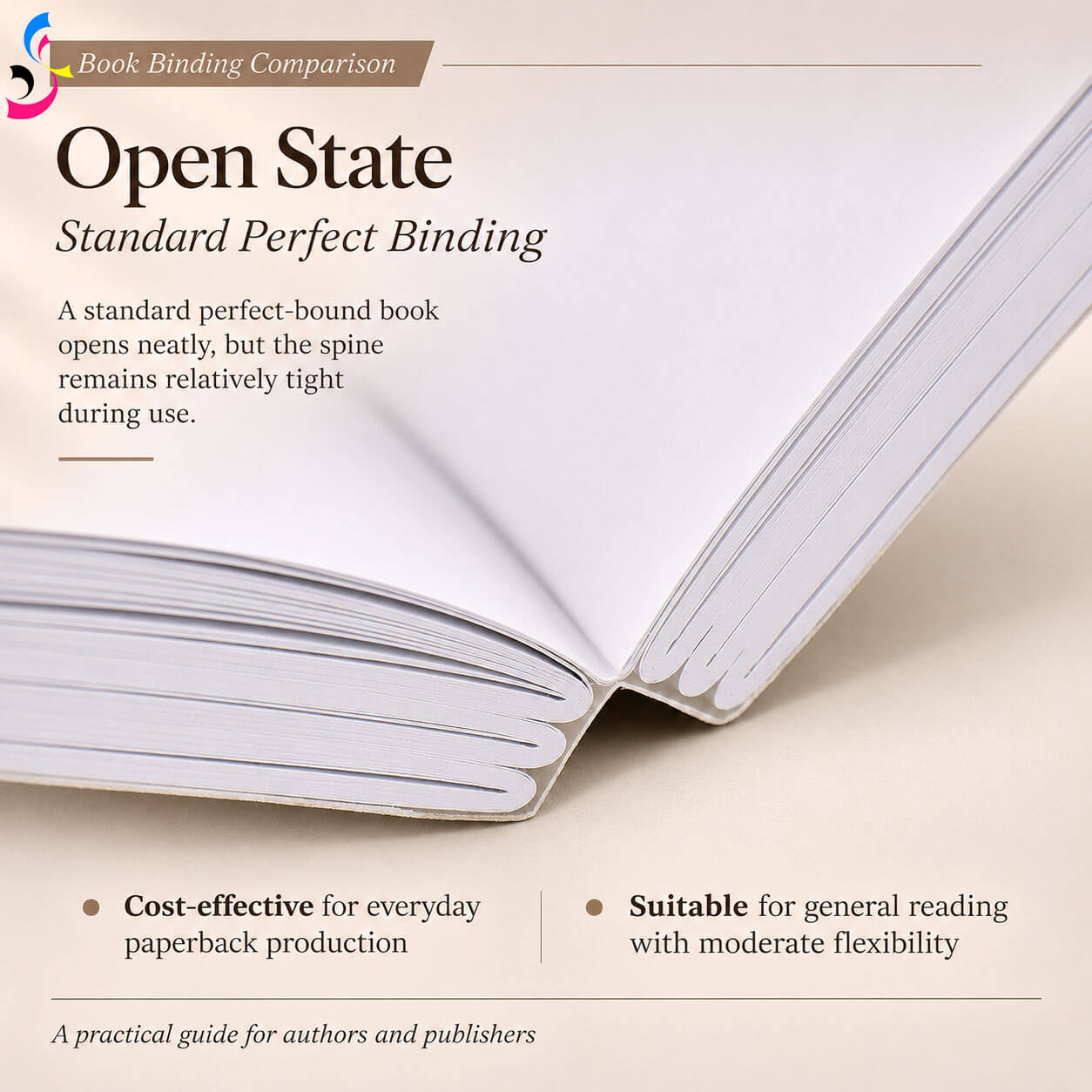
EVA is a thermoplastic hot melt adhesive. It is heated until it becomes liquid, applied to the prepared spine, and then cooled to form a bond. It is widely used in standard paperback production because of its fast setting time, efficient processing, and relatively low cost.
Its main characteristics include:
- Fast cooling and setting, supporting efficient mass production.
- Suitable for many standard uncoated paper stocks.
- Economical for large-volume paperback projects.
- Generally less flexible and less heat-resistant than PUR.
PUR Binding
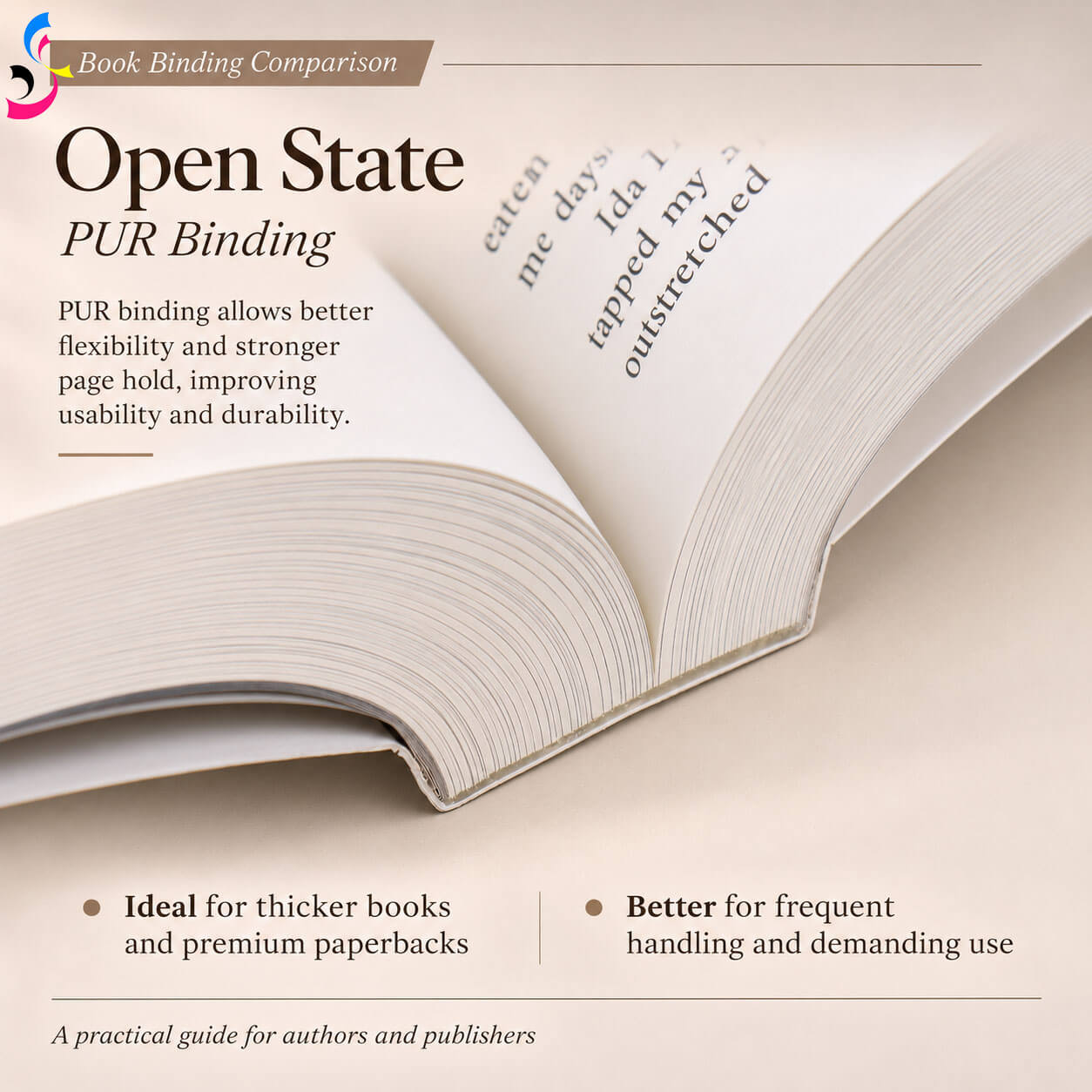
PUR is a reactive polyurethane adhesive that bonds through a chemical reaction with moisture in the surrounding environment. Unlike EVA, it continues curing after application and develops its final bonding properties over time.
Its main characteristics include:
- Strong adhesion to many coated and uncoated papers.
- Greater flexibility after proper curing.
- Better resistance to heat and moisture.
- Good page retention when used with appropriate paper and production settings.
- Higher material costs and more demanding production controls.
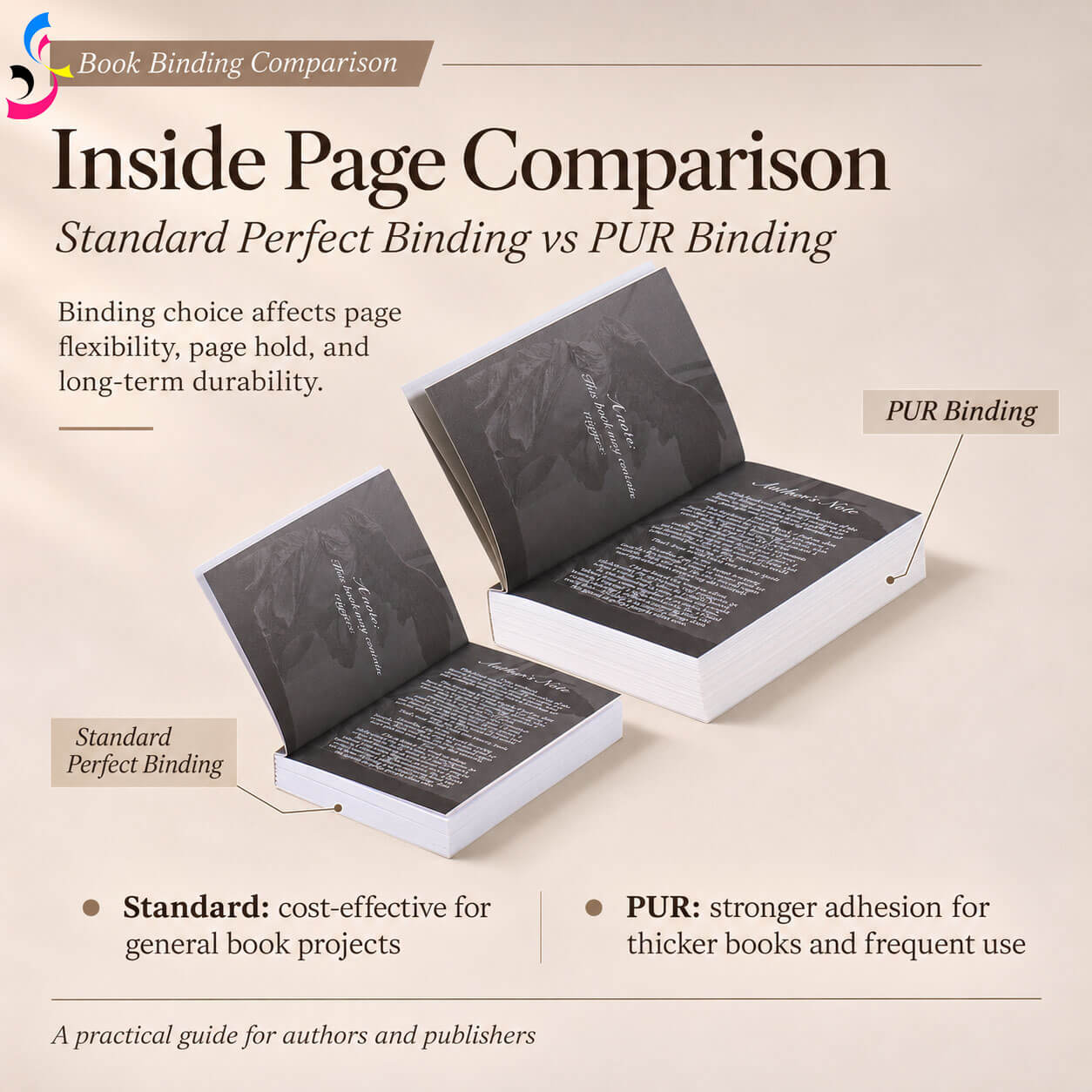
The key difference is that EVA relies on cooling to set, while PUR undergoes a moisture-triggered curing process. This affects their bonding performance, flexibility, and production requirements.
2. Lay-Flat Performance: Which Binding Opens Better?
A book's opening performance directly affects the reading experience. Readers generally prefer books that open comfortably without requiring excessive pressure on the spine.
EVA Binding:
EVA-bound books provide reliable opening performance for many standard paperback applications. However, the adhesive layer may feel relatively rigid, particularly in thicker books or books with heavier paper. Readers may need to hold the pages open to prevent them from closing.
PUR Binding:
PUR generally provides a more flexible adhesive bond after curing. This flexibility can help the spine bend more naturally when the book is opened, improving handling comfort and reducing stress on the binding.
PUR is often a suitable choice for books that require frequent opening or use heavier coated paper.
Does PUR Always Mean Lay-Flat Binding?
Not necessarily. Although PUR offers greater flexibility, it does not automatically create a true lay-flat book. The opening performance also depends on the binding construction, spine preparation, paper grain direction, page count, and cover materials.
For projects that require a genuinely flat opening, additional binding structures may need to be considered rather than relying on adhesive selection alone.
3. Corner Damage: Which Adhesive Provides Better Page Retention?
Loose pages and damaged page corners are common concerns in paperback book production. When a book is frequently handled, transported, or opened, insufficient adhesive bonding can cause pages to loosen or detach from the spine.
EVA Binding:
EVA provides dependable page retention for many standard book projects when the spine is properly prepared and the adhesive is correctly applied. However, its bonding performance can be more sensitive to certain coated papers and surface conditions.
If the adhesive does not bond effectively with the paper, pages may gradually loosen, particularly under repeated handling or stress.
PUR Binding:
PUR generally offers stronger adhesion across a wider range of paper types, including many coated stocks. Its flexible bond helps maintain page attachment during repeated opening and closing, reducing the risk of pages pulling away from the spine.
This makes PUR a good option for books that require higher durability and frequent use.
What Causes Corner Damage?
It is important to distinguish between adhesive failure and physical corner damage. Damaged page corners are not necessarily caused by the glue itself. Common contributing factors include:
- Insufficient Adhesion: Poor bonding can allow individual pages to become loose.
- Improper Spine Preparation: Inadequate milling or surface preparation can weaken the adhesive connection.
- Excessive Handling: Repeated bending, pulling, and rough use can damage pages and binding areas.
- Transportation Pressure: Poor stacking, compression, or insufficient packaging protection can cause bent or crushed corners.
To improve finished-book quality, manufacturers should inspect both page retention and physical condition throughout production and packaging.
4. Glue Oozing: How to Prevent Adhesive Overflow
Glue oozing occurs when excessive adhesive spreads beyond the intended binding area, leaving visible residue along the spine or between pages. It can affect the appearance of a finished book and, in severe cases, interfere with page opening.
Common Causes of Glue Oozing
- Excessive Glue Application: Applying too much adhesive can cause glue to spread beyond the spine area.
- Incorrect Temperature: Improper operating temperatures can affect EVA adhesive viscosity and application consistency.
- Incorrect Machine Settings: Poorly adjusted glue rollers, nozzles, or application systems may result in uneven glue distribution.
- Improper Spine Preparation: Inconsistent spine milling can affect adhesive coverage and bonding.
- Inadequate Production Control: Incorrect adhesive quantities or inconsistent machine operation can lead to visible glue residue.
EVA vs PUR: Glue Oozing Differences
EVA and PUR both require accurate adhesive application. EVA is generally easier to process and clean up during production because it sets through cooling. However, excessive application can still result in visible glue lines or residue.
PUR requires more specialized equipment and careful control of application conditions. Its curing process also requires appropriate handling and production management. Incorrect application can lead to adhesive overflow and an uneven spine appearance.
How to Prevent Glue Oozing
To achieve a clean and professional binding finish, manufacturers should:
1. Control the adhesive application amount and thickness.
2. Maintain appropriate operating temperatures for EVA and suitable processing conditions for PUR.
3. Regularly check and adjust glue application equipment.
4. Ensure consistent spine milling and preparation.
5. Inspect finished books for excess adhesive, uneven glue lines, and visible residue.
Proper machine adjustment and production inspection are essential for both binding methods. Choosing PUR instead of EVA does not automatically eliminate glue oozing.
5. EVA vs PUR: Side-by-Side Performance Comparison
Both adhesives have advantages, but their performance varies depending on paper selection, book construction, and production conditions.
The following table summarizes their main differences:
| Performance Factor | EVA Binding | PUR Binding |
|---|---|---|
| Adhesive Type | Thermoplastic hot melt | Reactive polyurethane |
| Setting Process | Cooling | Moisture-triggered curing |
| Bonding Strength | Good | Generally higher |
| Flexibility | Moderate | Higher after curing |
| Lay-Flat | Performance | Standard Generally better |
| Page Retention | Good | Generally stronger |
| Coated Paper Adhesion | More challenging | Generally better |
| Heat Resistance | Lower | Higher |
| Moisture Resistance | Moderate | Generally higher |
| Production Speed | Fast setting | Requires curing time |
| Production Cost | Cost More economical | Higher |
Overall, EVA is a practical and cost-effective choice for standard paperback books, while PUR offers advantages in adhesion, flexibility, and resistance to environmental conditions. Actual results depend on adhesive formulation, paper characteristics, and manufacturing quality.
6. Which Binding Should You Choose for Your Book?
The best adhesive depends on the book's intended use, paper specifications, durability requirements, and production budget. Neither EVA nor PUR is suitable for every project.
Here are some practical recommendations:
Choose EVA Binding If:
- You are printing standard novels, fiction books, or general paperback books.
- Your project uses conventional uncoated paper.
- You need an economical solution for large-volume production.
- Fast production and efficient turnaround are important.
Choose PUR Binding If:
- Your book uses coated or heavier paper stocks.
- You require stronger page retention and greater binding flexibility.
- Your books will be frequently handled or opened.
- Durability and long-term performance are important priorities.
Quick Recommendations by Book Type
| Book Type | Suggested Binding |
|---|---|
| Standard Novels | EVA |
| Paperback Fiction Books | EVA or PUR |
| Photography and Art Books | PUR, depending on construction |
| Heavily Coated Paper Books | PUR |
| Frequently Used Reference Books | PUR |
| Cost-Sensitive Large-Volume Books | EVA |
7. How SESE Printing Controls Perfect Binding Quality
At SESE Printing, we understand that high-quality book binding involves more than simply choosing the right adhesive. Paper compatibility, spine preparation, machine settings, and production inspection all contribute to the final result.
Our book manufacturing process focuses on several important quality-control points:
Proper Material Selection
We consider paper type, thickness, coating, and book specifications when determining the appropriate binding solution.
Consistent Spine Preparation
Accurate spine milling and surface preparation help create suitable conditions for adhesive bonding and improve page retention.
Controlled Adhesive Application
We monitor glue application to maintain consistent coverage and reduce the risk of excessive adhesive, uneven glue lines, and visible residue.
Binding Quality Inspection
Finished books are checked for spine appearance, page adhesion, opening flexibility, and other visible binding defects.
Finished Product Protection
Proper stacking, handling, and protective packaging help minimize corner damage, pressure marks, and other issues during storage and transportation.
SESE Printing provides custom paperback and hardcover book printing solutions for publishers, brands, and businesses worldwide. From paper selection and binding specifications to finishing and packaging, we support customized manufacturing projects with a focus on consistent production quality.
Whether you need standard paperback novels or premium books with specialized paper and finishing requirements, our team can help evaluate suitable printing and binding solutions based on your project specifications.
8. Conclusion: EVA or PUR – Which One Wins?
So, which adhesive wins the showdown?
The answer depends on your book's requirements.
EVA wins on cost efficiency and production speed. It is a reliable choice for standard paperback books, novels, and large-volume printing projects where economical production is a priority.
PUR wins on bonding performance and flexibility. It is particularly suitable for coated paper, frequently handled books, and projects requiring stronger page retention and better resistance to heat and moisture.
However, neither adhesive can compensate for poor spine preparation, incorrect machine settings, or inadequate quality control. A well-produced EVA-bound book can outperform a poorly manufactured PUR-bound book.
Ultimately, the best binding solution combines the right adhesive, suitable materials, precise production control, and careful inspection.
Looking for a reliable book printing manufacturer? Contact SESE Printing to discuss your custom paperback book printing requirements and find the right binding solution for your next project
 How to Print a Coffee Table Book: Paper, Size, Binding & Finishing Guide
 You May Also Like

 Tel
 Email
 Address
702 No. 21 Huizhong Road, Shiqiao St, Panyu District. Guangzhou city, Guangdong Province. China

Joy
 Whatsapp